Loading editorial…
World
The Theater of American Power Projection
Indictments, strikes, and war powers votes reveal the machinery of imperial management, not grand strategy.

All the world's a stage, and all the men and women merely players.
- William Shakespeare
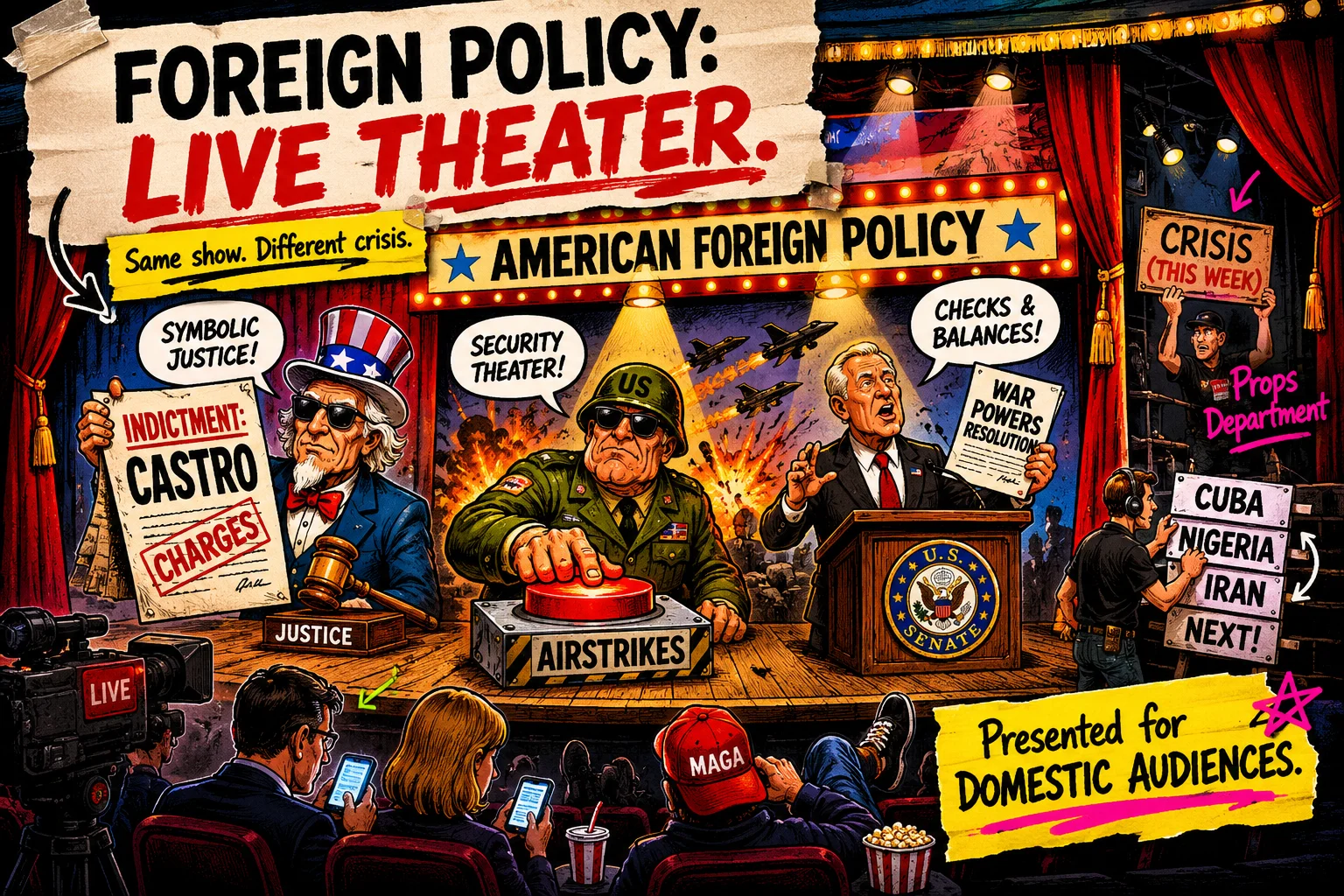
American statecraft has a rhythm to it, and this week we saw it in three-part harmony. The Guardian reported that the US indicted former Cuban president Raúl Castro as it seeks to oust the regime. Simultaneously, Al Jazeera noted that Nigeria said joint US strikes killed 175 ISIL fighters in the country's northeast. And in Washington, the Senate advanced a resolution to curb Trump's power to wage war on Iran. Three moves on a board most Americans stopped watching years ago.
The through-line connecting these is not strategic coherence but something more fundamental to how American institutions manage their relationship with the outside world: they perform. The indictment of Castro is symbolic justice dressed in legal robes. The strikes in Nigeria are counterterrorism dressed in security doctrine. The Senate resolution is legislative concern dressed in checks and balances. Each is real in its immediate effects and completely theatrical in its larger implications.
Start with Cuba. The Guardian reported that Cubans were outraged at US charges but viewed military strikes as a serious possibility. This tells you everything about what the indictment actually does: nothing that law can accomplish. A seventy-year-old former leader of a country ninety miles away cannot be tried, extradited, or detained by these charges. The indictment is not a legal mechanism. It is rhetoric with footnotes. It signals to a domestic audience that someone is doing something about Cuba. It tells allies that America has not forgotten. It tells enemies that America is angry. None of these messages require a courtroom, but they all benefit from one.
Then there are the strikes. Joint operations with Nigeria against ISIL fighters serve immediate tactical purposes—dead fighters cannot conduct operations—and broader ceremonial ones. They demonstrate that America is where the action is, that American military capacity provides value to regional partners, that terrorism is being managed. Whether 175 fighters represent a meaningful reduction in militant capability or a rounding error depends on information most citizens will never access. The operation succeeds politically regardless.
The Senate resolution on Iran war powers is perhaps the most transparent example of the performance. Constraining a president's ability to wage war is theoretically Congress's job. That it requires a formal resolution, that it provokes headlines, that it represents the first time a certain vote has advanced—all of this suggests how rarely the legislative branch actually exercises this power. The fact that a Republican senator needed visible harm to change his vote tells you something about what drives these institutional assertions. They happen not as principle but as reaction to a sufficiently dramatic provocation. The system corrects itself not through steady constitutional architecture but through periodic convulsion.
None of this means nothing. Indictments have diplomatic weight. Military strikes have real consequences. War powers resolutions, however rarely deployed, do constrain actual authority. But the pattern reveals that American foreign policy operates simultaneously as law, war, and theater—and that the theater is often where the real action occurs. The audience is domestic. The script is predetermined. The outcome serves institutional continuity rather than strategic clarity. This is not unique to any single administration or party. It is how the machinery of American power projection has always worked. It is spectacular because it works, and it works because it is spectacular.